Velox is an Arch-based rolling-release distro built for everyone — whether you're escaping Windows for the first time or a power user who wants a fast, secure, no-compromises system.
Velox was designed so you don't need to know what a terminal is to have a great system. Everything you expect is already there.
Taskbar at the bottom, app launcher, system tray, clock — Velox's KDE and Cinnamon desktops look and feel like what you're already used to. No relearning how to use a computer.
Click through the Calamares installer just like any Windows setup wizard. Pick your language, timezone, username, and partition — done. No commands, no config files.
Firefox, VLC, OBS Studio, GIMP, VS Code are pre-installed. Steam, Lutris, Heroic, Discord, Spotify, and thousands more are one click away in the Velox Control Center — including a full gaming setup without touching a terminal. Many Windows apps may also run on Velox via Wine or compatibility layers.
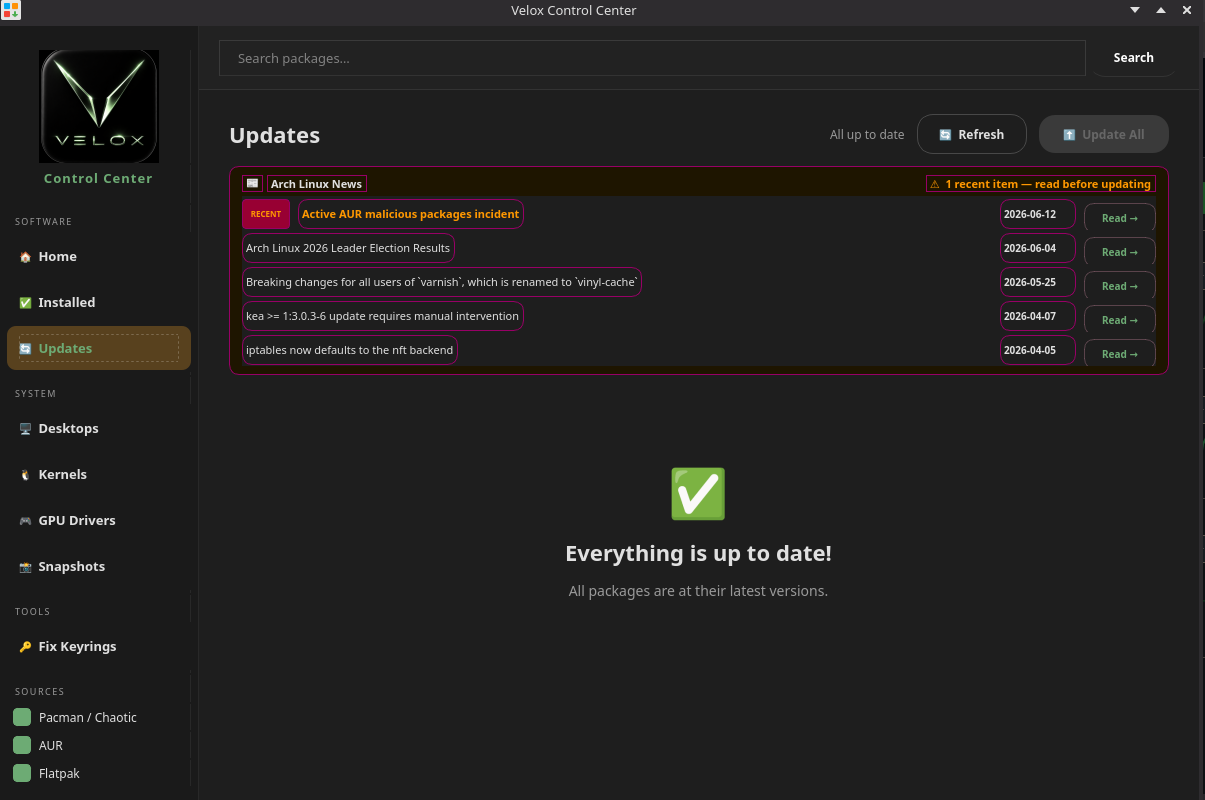
One-click system updates from the Velox Control Center. No restart required for most updates, no Windows Update rebooting you mid-project. You update when you want to.
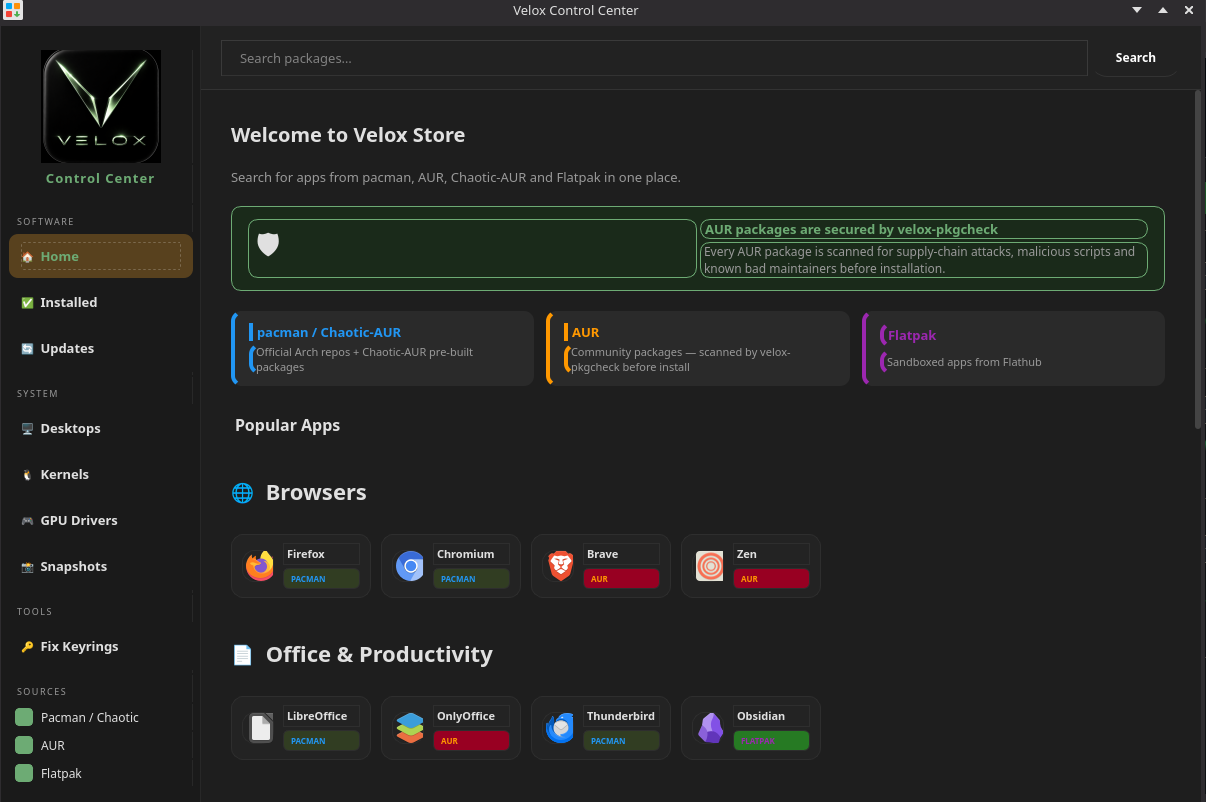
Search and install thousands of apps from the Velox Control Center — no need to find websites, download EXEs, or click through installers. It's like an app store, but everything is free.
Linux doesn't need antivirus software. Malware that targets Windows simply doesn't run here. Velox adds its own AUR scanner on top for an extra layer of peace of mind.
No license fees, no subscriptions, no activation keys. Velox Linux is open-source software and always will be. Download it, install it, and keep it as long as you want.
Velox runs fast on hardware that Windows 11 struggles on. The linux-velox kernel and performance tuning mean even older machines get a second life with smooth, responsive performance.
Velox (Latin: swift, fast, rapid) is an Arch-based distribution that gives you the full power of a rolling-release system with a polished installer, a curated software stack, and a custom control center that solves the four most common reasons people give up on Arch.
Three fully-themed desktops — KDE Plasma, Cinnamon, and XFCE — all running Wayland. Choose at install time.
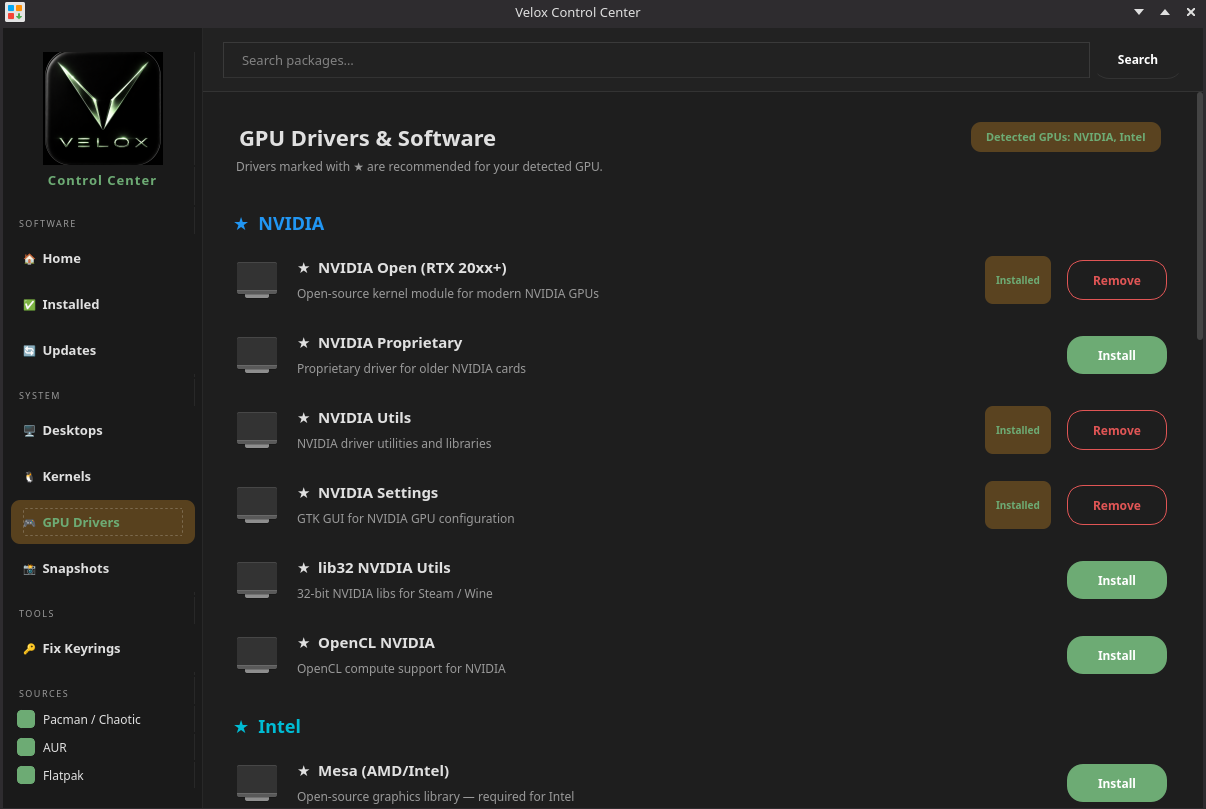
One app for everything — updates, drivers, kernels, AUR installs, snapshots, and more.
Search pacman, Chaotic-AUR, AUR, and Flatpak in one place.
Install NVIDIA, AMD, and Intel drivers with a single click.
Switch between linux-velox, linux-lts, linux-zen, linux-hardened, and linux-rt.
Add GNOME, XFCE, Cinnamon, Hyprland, and more alongside KDE.
Manage Snapper snapshots with a clean GUI — roll back anytime.
pacman + Flatpak in one button, with keyring refresh built in.
These aren't opinions — they're solutions to documented, recurring failures that have appeared in Arch forums and Linux press for years.
archlinux-keyring goes stale, pacman throws invalid or corrupted package (PGP signature) errors and refuses to update entirely. pacman depends on a keyring it doesn't automatically keep fresh.
archlinux-keyring. If it's older than 7 days it refreshes it in the background via pkexec — no user action needed. Update All always refreshes the keyring first, so updates can never fail on expired keys.
librewolf-fix-bin, firefox-patch-bin, and zen-browser-patched-bin — were found to be actively malicious, running cryptocurrency miners and exfiltrating credentials. AUR helpers like paru and yay have no built-in scanning.
velox-pkgcheck before installation. It reviews the PKGBUILD for suspicious patterns, outbound network calls, eval/exec usage, and obfuscated code. A severity rating is shown and you can cancel or proceed.
libfoo.so.6 when your system has libfoo.so.5 silently breaks other software. The ArchWiki explicitly states: "Partial upgrades are unsupported on Arch Linux." Nothing enforces it.
pacman -Syu first — preventing the most common cause of broken Arch installations.
Velox ships linux-velox — a custom kernel forked from CachyOS with every performance patch the upstream team has spent years tuning.
CachyOS's Burst-Oriented Response Enhancer scheduler on top of EEVDF dramatically improves desktop responsiveness and frame consistency under mixed workloads — gaming while compiling, streaming while gaming.
Tuned to 1000Hz (vs 300Hz default) for lower input latency and smoother animation. Every keypress and mouse event gets a faster response from the kernel.
Full preemption enabled — the kernel can interrupt itself to service higher-priority tasks. Eliminates stutters when background work competes with your foreground app.
RAM-backed compressed swap with zstd compression. Effectively multiplies usable RAM before touching disk — system stays snappy even when memory is under pressure.
CachyOS's ananicy-cpp rules automatically assign CPU priorities and scheduling classes to hundreds of known processes — games get high priority, background daemons get low.
CPU governor is pinned to performance on boot. No throttling, no frequency scaling delays — the CPU runs at full speed, ready to respond instantly.
Every distro ships software. We fixed the things that actually break the experience.
KDE Plasma 6 on Wayland ignores dock position hints from native Wayland apps. ksmoothdock was landing wherever it wanted on every boot. We force it into XWayland mode (QT_QPA_PLATFORM=xcb) so KWin obeys EWMH positioning, add a 3-second delayed start so KDE finishes applying your monitor resolution before the dock calculates its position, and wrap it in a restart loop so it survives screen lock. Result: bottom-center, every single boot.
SDDM with DisplayServer=wayland tries to launch weston if no compositor is specified — weston isn't installed, so SDDM just hangs. We wire in CompositorCommand=kwin_wayland --no-lockscreen explicitly. The login screen uses KWin directly, avoiding DRM permission errors when the user session starts its own KWin on top.
KDE's default Leaf theme had invisible list item hover states (opacity set to 0.001 with no fill). We rebuilt KvDark.svg, viewitem.svg, listitem.svg, button.svg, and actionbutton.svg with green (#8ab87a) glass hover effects — white frame borders at correct opacity for depth, green left-edge accent strip, translucent background. Every hover state in KDE now has consistent Velox styling.
Cinnamon 6 renamed all shell widget classes from menu-* to appmenu-* — most third-party themes still target the old names and get nothing. We rewrote the CSS targeting the correct Cinnamon 6 class names across app launchers, categories, taskbar buttons, panel buttons, system tray, workspace switcher, and popup menus. Glass hover with green left-edge accent throughout.
xfce4-panel on Arch is not compiled with gtk-layer-shell, so it floats as a regular window instead of anchoring to the screen edge. Plank is X11-only. We replaced xfce4-panel with waybar (top) and crystal-dock (bottom) — both have native Wayland layer-shell support and are launched via autostart with GTK_THEME=Adwaita to prevent the system GTK theme from overriding our custom CSS colors.
labwc (the Wayland compositor powering XFCE Wayland) looks for themes at labwc/themerc — not openbox-3/themerc like older documentation says. Every existing XFCE Wayland theme ships in the wrong path, gets silently ignored, and the right-click menu falls back to plain white. We wrote the Velox-Dark labwc theme in the correct path with green highlight colors.
Cinnamon's wallpaper picker scans /usr/share/gnome-background-properties/ for XML descriptors — it ignores image files that don't have one, even if they're installed. We ship velox.xml pointing to all 15 Velox wallpapers, and run a post-install cleanup script that strips wallpapers from other packages (installed by Cinnamon's dependencies) so only Velox wallpapers appear in the picker.
The Calamares installer was showing a white OpenBox title bar and border frame around the window — a mismatch with the dark themed installer content. Qt stylesheet rules don't touch window manager chrome. The fix is an OpenBox application rule with decor=no targeting the class "calamares" (lowercase — WM_CLASS is all lowercase; using a capital C silently fails to match).
The Calamares partitioner defaulted to only offering ext4, despite btrfs-progs being installed and the installer slideshow advertising BTRFS snapshot support. One missing "btrfs" entry in partition.conf's availableFileSystemTypes array was hiding it. Now BTRFS is a first-class option in the partitioner alongside ext4.
performance on bootThree fully-featured desktops, each tuned with Velox styling from the first boot.
The flagship Velox desktop. KDE Plasma 6 on Wayland with ksmoothdock dock, Papirus-Dark icon theme, and the leaf-dark color scheme.
Familiar traditional layout on a modern Wayland stack. Nemo file manager with green-accented menus and Fluent-Velox-Dark GTK theme throughout.
Lightweight and fast. Waybar top panel and Crystal Dock bottom dock, with nwg-drawer as the app launcher — all styled with Velox dark-green colors.
| CPU | 64-bit x86 (2+ cores) |
| RAM | 2 GB |
| Storage | 20 GB |
| GPU | Any GPU with KMS |
| Boot | UEFI or Legacy BIOS |
| CPU | 64-bit x86 (4+ cores) |
| RAM | 8 GB+ |
| Storage | 40 GB+ SSD |
| GPU | AMD / Intel / NVIDIA |
| Boot | UEFI |
One ISO, all three desktops.
Use Ventoy or Balena Etcher.
Calamares installer launches automatically.
NVIDIA drivers install automatically if detected. Reboot and log in.
A single ISO with all three desktops — choose at install time.